
Epoxy Flooring vs. Concrete Paint: What’s the Difference?
When you line these options up against snow, salt, mud, and freeze-thaw specifically, a pattern shows up quickly. Uncoated concrete and thin acrylic sealers offer little resistance to any of it. Penetrating sealers protect the slab's structure but leave a working surface that still stains and shows wear. LVP brings a beautiful, warm look that fights against its own construction in a cold, wet garage. Tile can work but depends heavily on a stable substrate and careful installation. Rubber mats manage symptoms without solving the underlying moisture problem.
A fully bonded epoxy or polyaspartic coating system is the option built specifically to seal the slab, resist chloride intrusion, and handle the abrasive combination of grit, moisture, and cold that defines an Elk County winter — while still giving you a floor that is genuinely easy to clean after every storm.
Quick Answer: Concrete paint is a thin, single layer of color that sits on top of the slab, usually around 1 to 3 mils thick, while a professional epoxy flooring system is a thick, two part resin that bonds to a ground concrete surface and builds to 10 mils or more. That difference in thickness and bonding is why paint often begins peeling within one to two years in a garage, especially under hot tires, road salt, and moisture, while a properly installed epoxy system commonly lasts a decade or longer. Paint is cheaper to apply and fine for light duty spaces. Epoxy is the better fit for any floor that sees vehicles, tools, or Pennsylvania winters.
Picture a garage floor in early February. A truck has been parked on it for an hour, its tires still warm from the drive home, and a gray slush of road salt and melted snow is dripping off the wheel wells onto the concrete. When the truck pulls out the next morning, a small patch of the floor coating comes with it, stuck to the tire like a strip of tape. If your floor was finished with concrete paint, you have probably seen exactly this. If it was finished with a real epoxy system, you probably have not.
Both products get called "floor coatings," and at the hardware store they sit a few feet apart. They are not the same kind of material, though, and they do not behave the same way once a car, a winter, and a few years are piled on top of them. Here is what actually separates them.
What Concrete Paint Actually Is
Concrete paint, sometimes sold as garage floor paint or porch and patio paint, is a coating built on a latex or acrylic base. You roll it on, it dries as the water or solvent leaves, and what remains is a thin film of color on the surface. Some products are labeled "epoxy paint" or "epoxy acrylic," which sounds like an upgrade but usually means a small amount of epoxy has been blended into a water based formula.
Thickness
Paint goes down at roughly 1 to 3 mils per coat. A mil is one thousandth of an inch, so you are looking at a film thinner than a sheet of copy paper. Much of what you roll on evaporates as it dries, which is why paint is described as low solids.
Bond
Paint mostly grips the surface through adhesion, meaning it sticks to the top of the slab without locking into it. That works on a wall. On a floor that gets driven on, it is the weak point.
Where It Works
For a lightly used basement corner, a storage room, or a floor you only want to brighten and dust proof, paint does a fair job. The trouble starts when the floor has to carry weight, heat, or chemicals.
What an Epoxy Flooring System Is
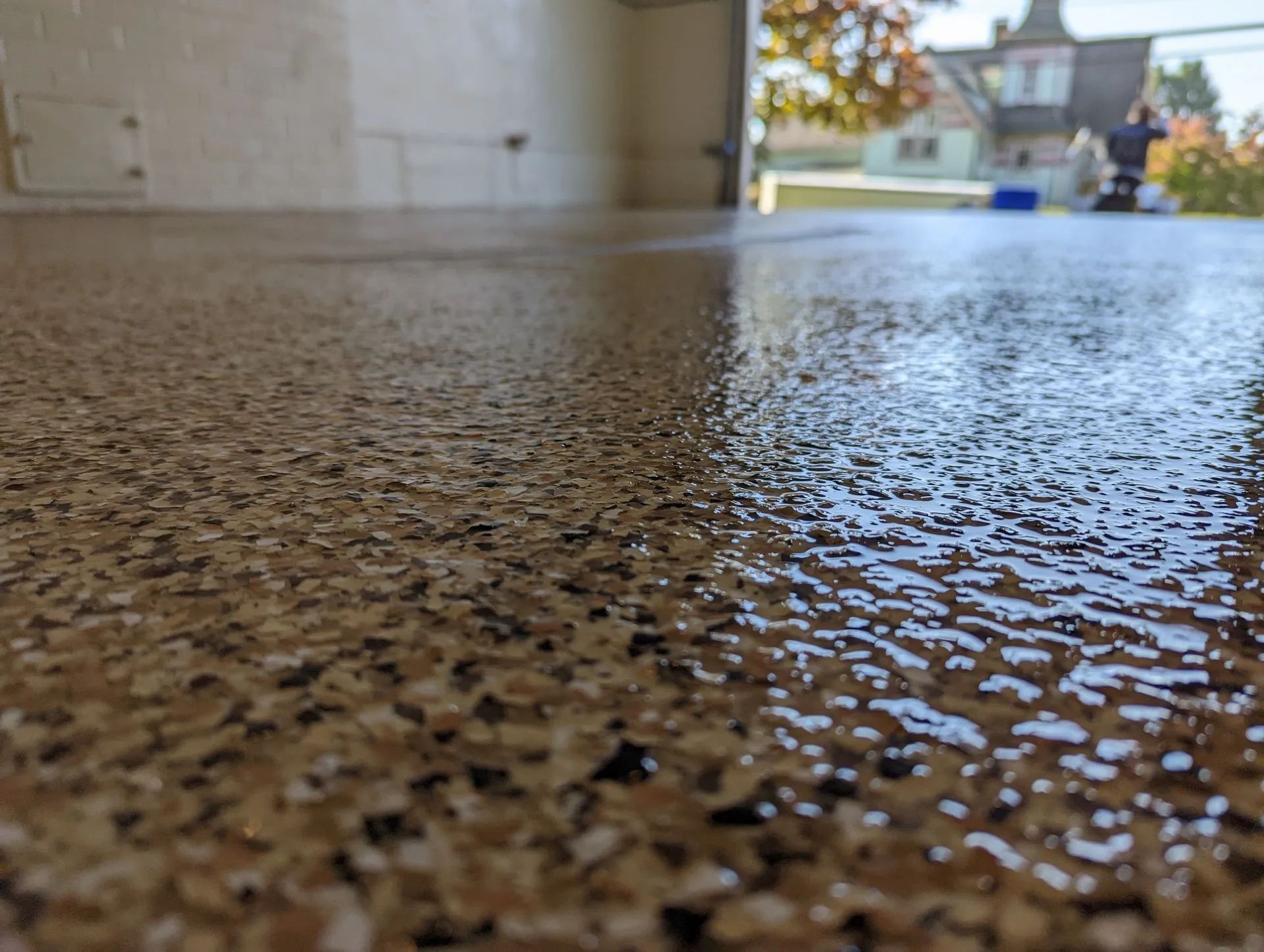
Epoxy is a two part thermoset. A resin and a hardener are mixed on site, and the two react chemically and cure into a hard plastic. Nothing needs to evaporate for it to harden, so a 100% solids epoxy leaves everything you put down on the floor. That is why an epoxy coating can be built up several times thicker than paint in a single pass.
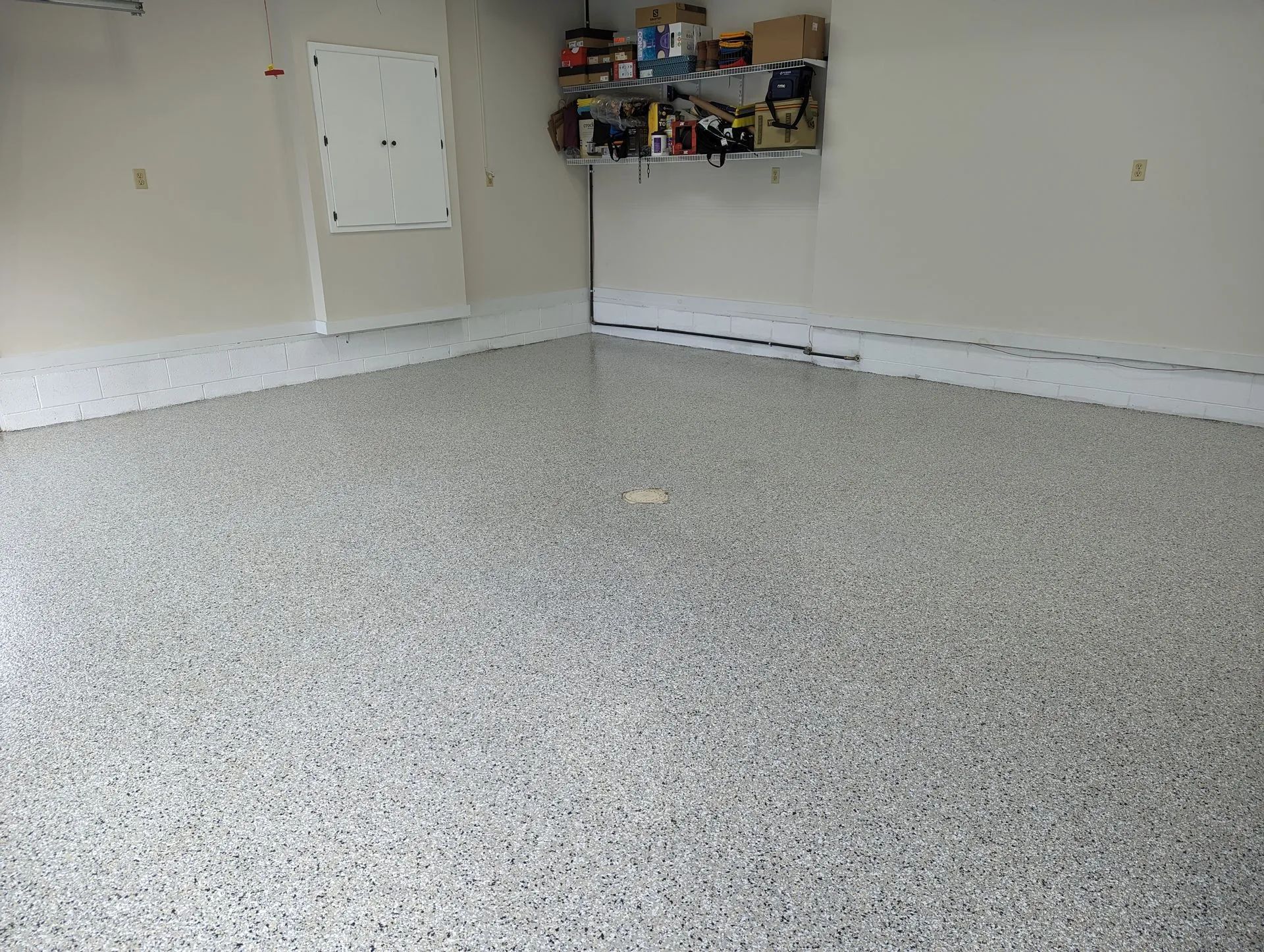
A full system is usually more than one product. It often starts with a primer or moisture control layer, adds a base coat, may include broadcast flake or metallic pigments for color and grip, and finishes with a clear topcoat, sometimes epoxy and sometimes polyaspartic. Professional systems commonly reach 10 to 20 mils or more, several times the film of paint.
Bond. Epoxy does not rely on surface tension. After the slab is diamond ground, the resin flows into the microscopic peaks and valleys of the concrete and hardens there, so the bond is mechanical as well as chemical. You can read more about why that step matters in our breakdown of concrete grinding before epoxy.
Why Thickness and Solids Change Everything
A floor coating has three jobs: resist wear, resist chemicals, and shrug off heat and moisture. Every one of those jobs gets easier when there is more coating on the floor.
Abrasion
Dragged toolboxes, dog nails, jack stands, and grit tracked in on boots grind against the surface all day. A film of 1 to 3 mils wears through in the paths people and cars actually travel, usually near the garage door and in front of the workbench. A thicker film has more material to lose before the concrete shows.
Chemicals
Motor oil, brake fluid, antifreeze, and gasoline can soften or discolor latex paint, and brake fluid in particular is known for lifting it. Epoxy resins are formulated for chemical exposure, and they cure into a dense film that fluids sit on rather than soak into.
Imperfections
A thicker coating also hides more. Pinholes, small surface flaws, and hairline shrinkage marks stay visible under paint but disappear under a built up system.
The Hot Tire Problem
This one deserves its own section because it is the failure people notice first. When a car is parked, the tires hold heat from the road, and that heat softens whatever is under them. Latex paint has very little internal strength, so the warm rubber can pull the film off the slab in small patches, leaving tire shaped scars. Epoxy and polyaspartic systems have enough thickness and bond to take that thermal load without letting go, which is why hot tire pickup is far more common on painted garage floors than on coated ones.
What Northern Pennsylvania Does to a Floor Coating
A garage in Ridgway, St. Marys, DuBois, or Bradford has a harder job than the same garage in a mild climate. From December through March, a floor here takes salt brine and slush off the tires, then goes through repeated freezing and thawing as temperatures cross 32 degrees again and again. Unheated garages swing hard between cold nights and warmer afternoons, and the slab expands and contracts along with them.
Moisture
Concrete is porous and it moves moisture. Paint does not seal the slab, and it is not built to stand up to vapor pressure pushing up from below. Over time that pressure works under the film, and the paint blisters, bubbles, and flakes. A quality epoxy system can be paired with a moisture mitigating primer when a slab calls for it, which is one of the reasons we test before we coat.
Salt
Road salt sits on top of paint and works into every worn spot, then gets pulled into the concrete under it. The edges near the garage door, where salt and meltwater collect most, tend to fail first.
Cold
Temperature matters for the installation as much as for the life of the floor. Manufacturers set minimum surface and air temperatures for their
epoxy floor coatings. One widely used Sherwin Williams epoxy floor coating, for example, lists a 50 degree Fahrenheit minimum for the air, the surface, and the material, plus a margin above the dew point. A cold Elk County garage in November or March is not always ready to accept a coating, and planning around that is part of doing the job correctly.
Tip: Before you buy anything, tape a 2 foot square of clear plastic to your bare or painted slab, seal all four edges, and leave it for a day or two. If you see fogging or drops of moisture on the underside, the slab is moving water, and no coating, paint or epoxy, should go down until that is dealt with.
Preparation Is Where the Two Products Separate Again
Both products need a clean, sound surface, and both fail when that step is skipped. The difference is how much each one demands. Paint labels usually call for cleaning, degreasing, and an acid etch. Acid etching gives only a very light texture, and it cannot remove sealers or oil that has soaked into the slab.
Professional epoxy work starts with mechanical grinding. Manufacturer data sheets for floor coatings typically call for a prepared concrete surface profile in the range of CSP 1 to 3, set by the International Concrete Repair Institute, along with a surface that is clean, dry, and structurally sound. A grinder opens the top of the slab, strips old sealer and laitance, and leaves a surface a coating can key into.
That is also where many painted floors go wrong. Paint applied over a sealed, smooth, or oily slab has nothing to hold, so it peels in sheets rather than wearing evenly.
How Long Each One Lasts
Published comparisons commonly put concrete paint at 2 to 5 years in a garage, with some sources reporting peeling in as little as 1 to 2 years under vehicle traffic. Professional epoxy and polyaspartic systems are commonly described as lasting 10 to 20 years, depending on the system, the prep, and how the floor is used. Those are ranges rather than promises, and the results depend on the slab, the installer, and the winters the floor goes through.
Maintenance. A painted floor usually needs a fresh coat every few years, and each new coat needs the old one to be sound underneath. When the paint is already peeling, it has to be scraped or ground off first, which is more work than prepping bare concrete would have been.
When you line these options up against snow, salt, mud, and freeze-thaw specifically, a pattern shows up quickly. Uncoated concrete and thin acrylic sealers offer little resistance to any of it. Penetrating sealers protect the slab's structure but leave a working surface that still stains and shows wear. LVP brings a beautiful, warm look that fights against its own construction in a cold, wet garage. Tile can work but depends heavily on a stable substrate and careful installation. Rubber mats manage symptoms without solving the underlying moisture problem.
A fully bonded epoxy or polyaspartic coating system is the option built specifically to seal the slab, resist chloride intrusion, and handle the abrasive combination of grit, moisture, and cold that defines an Elk County winter — while still giving you a floor that is genuinely easy to clean after every storm.
When Paint Still Makes Sense
Paint has honest uses. A dry storage room, a utility closet, a shed floor that never sees a vehicle, or a basement corner where you just want to tie the room together and keep dust down are all reasonable places for it. If the floor is light duty and you accept that it will need repainting, it does its job.
The moment a floor has to handle hot tires, tools, chemicals, or repeated salt and freeze thaw exposure, the math changes. Garages, workshops, and commercial bays fall on the epoxy side of that line, and so does any floor where you want to stop redoing the work.
Warning: Applying a fresh coat of paint or a store bought epoxy kit over an existing sealer, a peeling coating, or a damp slab almost always fails early. The old layer or the trapped moisture becomes the weak link, and the new coating peels off along with it.
How to Tell What Is on Your Floor Right Now
If you bought the house and do not know what is on the slab, a few checks help. Scratch a small area near a wall with a coin. Paint tends to flake or scrape into fine chips, while epoxy usually feels hard and resists a scratch. Look at the finish: paint often looks flat or satin and slightly chalky, while epoxy has a glassy, self leveling look. Check the tire tracks and door edge for peeling, since that is where a weak bond shows first.
Frequently Asked Questions
Is epoxy paint the same thing as epoxy flooring?
No. One part "epoxy paint" is usually a latex or acrylic base with some epoxy added, and it cures by drying. Professional epoxy is a two part resin that cures chemically and builds much thicker.
Can I put epoxy over concrete paint?
Not directly in most cases. The paint usually has to be ground off first, since epoxy is only as strong as the layer beneath it. Peeling or sealed floors need grinding back to bare concrete.
Why does my garage floor paint peel where I park?
Hot tires soften thin latex films, and moisture, salt, and chemicals dripping from the car work into those weak spots. Peeling along the tire path is a clear sign paint was the wrong product there.
Is epoxy slippery when wet?
Smooth, glossy epoxy can get slick with water or snowmelt. Broadcast flake, a textured topcoat, or an anti slip additive improves grip, which we recommend for local garages where wet boots and tires are constant.
How long does epoxy take to cure compared with paint?
Paint dries to the touch in hours, while epoxy cures chemically. Data sheets list about 48 to 72 hours before heavy traffic and up to a week for full cure, with cold slabs taking longer.
Will epoxy crack or peel in a Pennsylvania winter?
A well prepped, correctly installed system handles freeze thaw cycles and salt. Problems almost always trace back to skipped grinding, trapped moisture, or coating a slab too cold to cure properly, not the epoxy itself.
Choosing a Floor Coating That Survives Pennsylvania Winters
The real difference between concrete paint and epoxy has little to do with color or finish. One is a thin film resting on a smooth slab, while the other is a thick resin locked into a properly ground and cleaned surface. A northern Pennsylvania garage, with its hot tires, road salt, and freeze thaw swings, gives that difference every chance to show itself within the first winter or two, usually right along the tire paths where the vehicle parks each night.
At Pa Epoxy Works
in Ridgway, PA, we have spent 8
years coating garage, shop, and commercial floors across the region, and the pattern rarely changes. Floors that last start with honest moisture testing, thorough grinding, and a system matched to how the space is really used. When those steps are handled with care, the coating stays firmly bonded through slush, salt, and cold snaps, and the floor quietly becomes one less thing to worry about redoing every few years.
Recent Posts